March/April 2026
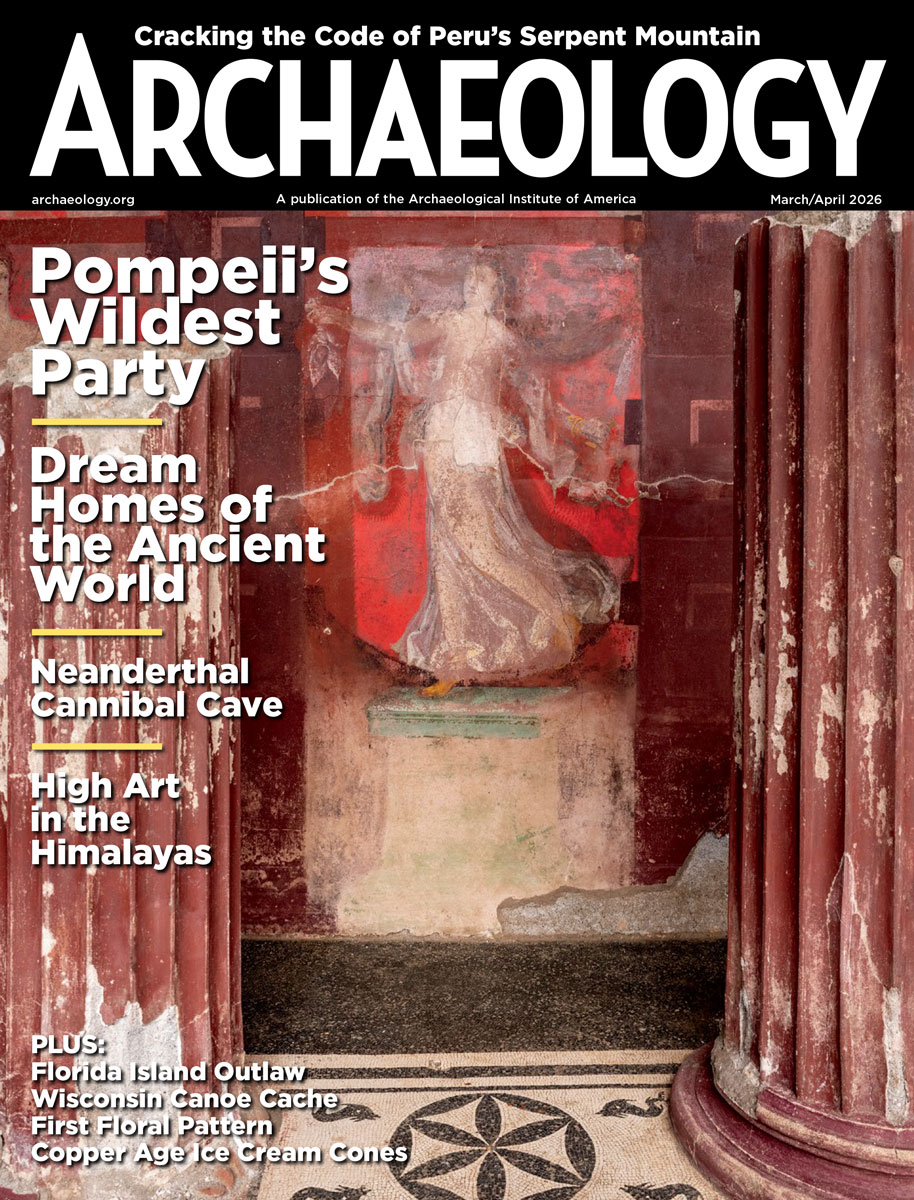
Features From the Issue Explore All Features Model Homes A look inside miniature worlds created for the living, the dead, and the divine Read Article The Metropolitan Museum of Art, New York, Gift of Joanne P. Pearson, in memory of Andrall E. Pearson, 2015 Features Pompeii's House of Dionysian Delights Vivid frescoes in an opulent dining room celebrate the wild rites of the wine god Read Article Courtesy Archaeological Park of Pompeii Features Return to Serpent Mountain Discovering the true origins of an enigmatic mile-long pattern in Peru’s coastal desert Read Article Courtesy J.L. Bongers Features Himalayan High Art In a remote region of India, archaeologists trace 4,000 years of history through a vast collection of petroglyphs Read Article Matt Stirn Features What Happened in Goyet Cave? New analysis of Neanderthal remains reveals surprisingly grim secrets Read Article IRSNB/RBINSL Letter from Wisconsin Letter from Wisconsin People of the Sacred Voice The Ho-Chunk Nation safeguards a legacy that includes an underwater cache of ancient canoes Read Article Courtesy William Quackenbush Explore All Artifact Artifacts Caspian Tiger Figurine Read Article The Metropolitan Museum of Art, New York, H. Dunscombe Colt Gift, 1963 Explore All Digs & Discoveries Explore all Digs & Discoveries The Path Not Taken Read Article Louise N. Leakey Digs & Discoveries Cup or Cone? Read Article Sharon Zuhovitzky, courtesy of the Pontifical Biblical Institute Digs & Discoveries Roman River Barge Read Article Courtesy Anton Divić/Navarchos Digs & Discoveries Prehistoric Plant Pots Read Article Courtesy Yosef Garfinkel Digs & Discoveries Egypt’s Temple of Creation Read Article Mountains Hunter/AdobeStock Digs & Discoveries Reindeer Harvest Read Article Adnan Icagic, Universitetsmuseet, UiB Digs & Discoveries Roman Gaul’s Literati Read Article Renaud Bernadet Digs & Discoveries Imperial Sugar Read Article Azriel Yechezkel Digs & Discoveries Viking Mollusk Mask Read Article Raymond Sauvage/NTNU Vitenskapsmuseet Off the Grid Explore All Off the Grid March/April 2026 Indian Key, Florida Read Article Ben O’Donnell Around the World Explore GUATEMALA Read More About GUATEMALA IRELAND Read More About IRELAND UKRAINE Read More About UKRAINE More Locations J. Hiquet et al., Latin American Antiquity (2025) GUATEMALA Games were such an integral part of Maya society that they were sometimes embedded into a building’s design. A unique fifth-century a.d. patolli gaming board was found on the floor of a wealthy residential complex in the ancient city of Naachtun. While most known patolli boards—which feature a pattern of squares forming a cross—were roughly scratched into stucco floors or benches, this one was inlaid as a mosaic. It is the only one of its kind. Related Content Around the World November/December 2025 GUATEMALA Read Article Ramírez-Salomón et al, Journal of Archaeological Science: Reports (2025) Around the World January/February 2023 GUATEMALA Read Article (Wikimedia Commons) Close D. Brandherm et al., Antiquity (2025) IRELAND The Vikings have long been credited with building Ireland’s first towns in the ninth century a.d. New evidence from County Wicklow, however, indicates that Irish urban traditions might be much older. A survey of the Brusselstown Ring hillfort, which was inhabited between 1200 and 400 b.c., revealed as many as 600 possible house platforms located within two concentric circular ramparts. If these structures were, in fact, dwellings, this would be the largest prehistoric settlement ever discovered in Britain or Ireland. Related Content Around the World March/April 2022 IRELAND Read Article (Michele Comber) Around the World September/October 2020 IRELAND Read Article (Wikimedia Commons) Close Chu et al., Open Research Europe (2025) UKRAINE If there are few resources on hand, you build with what you’ve got. Some 18,000 years ago, during the last Ice Age, what people had was mammoth bone. Four circular structures built almost entirely from mammoth tusks and bones were discovered decades ago in the village of Mezhyrich. Archaeologists have been unsure whether they were houses, storage facilities, or ritual monuments. New data indicates that the structures were likely used as temporary dwellings that provided refuge during brief periods of extreme weather. Related Content Top 10 Discoveries of 2025 January/February 2026 The First Indo-European Speakers Eastern Ukraine and Southern Russia Read Article Erich Lessing/Art Resource, NY Searching for Lost Cities May/June 2024 London on the Black Sea Crimea, Ukraine Read Article (Heritage Image Partnership Ltd/Alamy) Close Videos: Aerial Views of the Band of Holes These videos offer a bird’s-eye view of the Band of Holes, one of the world’s most enigmatic built features. Rising from the Pisco Valley in southern Peru’s coastal desert, the band continues for nearly a mile into the foothills of the Andes. Drone imagery such as this has enabled archaeologists Charles Stanish of the University of South Florida and Jacob Bongers of the University of Sydney to arrive at a more precise count of the number of holes—approximately 5,200—and to identify previously unrecognized mathematical patterns in the arrangement of the holes. To read more about the Band of Holes, click here. Videos courtesy J. L. Bongers.


Comments
Post a Comment